


close
Choose Your Site
Global
Social Media
Views: 117 Author: Patrick Publish Time: 2026-01-09 Origin: Site


Split case pumps are the workhorses of high-flow applications, from municipal water treatment to industrial cooling systems. However, their ubiquity often leads to overlooked inefficiencies. According to the U.S. Department of Energy (DOE), pumping systems account for nearly 20% of the world’s electrical energy demand, yet industrial studies indicate that 30% to 50% of this energy is wasted due to poor sizing, operation, or maintenance [1].
Enhancing performance requires a systemic approach involving hydraulic optimization, advanced materials, and predictive analytics. Below are critical strategies for maximizing reliability and efficiency.
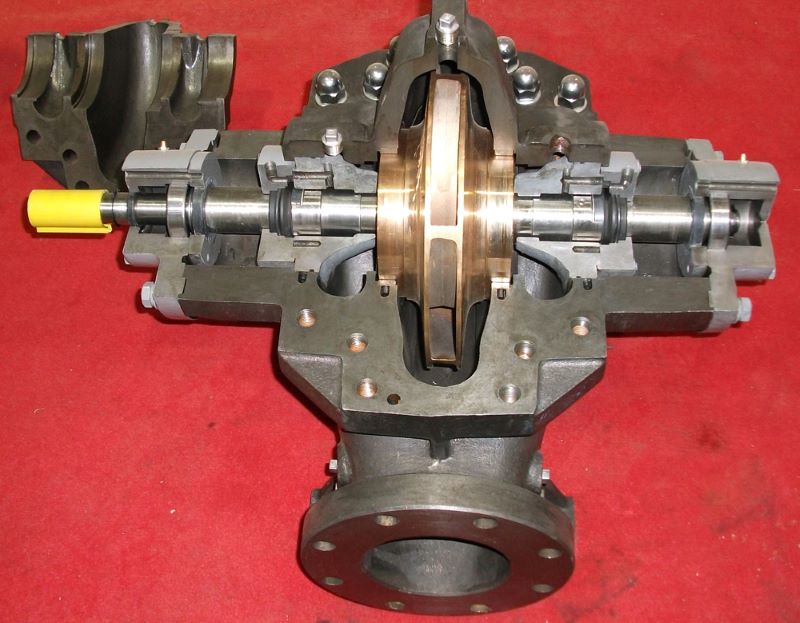
The single most significant factor in pump reliability is operating near the Best Efficiency Point (BEP).
The BEP Principle: A split case pump is designed to operate optimally at a specific flow rate and head. Operating too far left (low flow) or right (high flow) of the BEP curve induces cavitation, shaft deflection, and increased radial loads.
The Reliability Impact: Research published in the International Journal of Rotating Machinery indicates that bearing and seal life decreases exponentially when a pump operates outside of 80% to 110% of its BEP [2].
Solution - Impeller Trimming: If a pump is oversized, trimming the impeller is cost-effective. Data suggests that trimming an oversized impeller can reduce energy consumption by up to 15% while stabilizing hydraulic pressure.
Fixed-speed operation is a major source of energy waste. Implementing VFDs allows the pump speed to match the actual process demand.
The Affinity Laws: According to the Pump Affinity Laws, power consumption is proportional to the cube of the rotational speed. This relationship is expressed mathematically as:
P₂ = P₁ × (n₂ / n₁)⊃3;
Where:
P = Power (kW or HP)
n = Pump Speed (RPM)
Impact Analysis: A mere 10% reduction in speed (where n₂ is 0.9 of n₁) results in a significant power reduction:
P₂ = P₁ × (0.9)⊃3; = 0.729 P₁
This equates to approximately 27% energy savings.
Internal surface roughness creates friction losses that degrade efficiency, particularly in older pumps.
Material Science: Applying hydrophobic, ceramic, or epoxy coatings to the volute and impeller smooths wetted surfaces.
Efficiency Gains: A study by the Hydraulic Institute (HI) notes that applying high-performance coatings to rough cast iron surfaces can improve overall pump efficiency by 2% to 4% [3].
Corrosion Resistance: These coatings also act as a barrier against erosion-corrosion, significantly extending the Mean Time Between Failures (MTBF).
Mechanical energy losses often manifest as heat and vibration.
Laser Alignment: Misalignment is responsible for over 50% of rotating machinery failures. Laser alignment ensures the pump and motor shafts are collinear under operating temperatures.
Dynamic Balancing: Impellers must be dynamically balanced to reduce harmonic vibrations. The ISO 1940-1 standard recommends:
Grade G6.3: Standard industrial pumps.
Grade G2.5: High-speed or critical applications (mandated by API 610 standards) [4].
Older split case pumps often utilize packing glands, which create drag on the shaft.
Friction Reduction: Modern cartridge mechanical seals eliminate packing friction, reducing horsepower draw by approximately 1–2%.
API Flush Plans: Implementing correct API 682 flush plans (e.g., Plan 11 or Plan 53) ensures seal faces remain cool, preventing thermal distortion.
Moving from "fail-and-fix" to predictive strategies is the industry standard for high-reliability systems.
Smart Monitoring: IoT sensors now allow for continuous monitoring of temperature and vibration.
The Data: According to a report by Deloitte, predictive maintenance increases equipment uptime by 10–20% and reduces overall maintenance costs by 5–10% [5].
The following table summarizes the potential efficiency improvements based on the strategies discussed:
| Strategy | Primary Benefit | Est. Efficiency Gain | Standard/Source |
| VFD Installation | Energy Savings | 20% – 50% | Affinity Laws |
| Impeller Trimming | Hydraulic Stability | 5% – 15% | Hydraulic Institute |
| Internal Coatings | Friction Reduction | 2% – 4% | HI / Europump |
| Precision Alignment | Vibration Reduction | 1% – 2% | ISO 1940-1 |
U.S. Department of Energy (DOE), Industrial Technologies Program: Pumping Systems Tip Sheet.
International Journal of Rotating Machinery, Effects of Off-Design Operation on Pump Bearing Life.
Hydraulic Institute (HI), Pump Efficiency Prediction Guidelines.
ISO 1940-1: Mechanical vibration — Balance quality requirements for rotors in a constant (rigid) state.
Deloitte, Predictive Maintenance and the Smart Factory.
Ready to upgrade your pump system? Contact us now for a free consultation. Let's find the perfect fit for your industry.


