


close
Choose Your Site
Global
Social Media
Views: 110 Author: Patrick Publish Time: 2026-01-07 Origin: Site


Axially and radially split case pumps are the operational heart of municipal water systems, HVAC cooling loops, and industrial processing. However, due to their high duty cycles, they are also significant consumers of electricity.
According to the U.S. Department of Energy (DOE), industrial pumping systems account for nearly 25% of the energy consumed by electric motors in the United States. Furthermore, the Hydraulic Institute (HI) estimates that between 30% and 50% of the energy consumed by pumping systems could be saved through equipment or control system changes.
To capture these savings, engineers must move beyond simple component selection and adopt a systems-based approach.
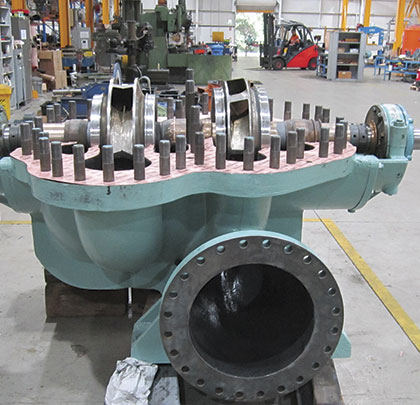
The most potent strategy for variable load applications is the implementation of Variable Frequency Drives (VFDs). Unlike throttling valves, which destroy head pressure to control flow, VFDs reduce the rotational speed of the impeller. The energy savings are governed by the Affinity Laws, specifically the cubic relationship between speed and power.
The relationship is expressed as:
P₁ / P₂ = (N₁ / N₂)⊃3;
Where:
P = Power (BHP)
N = Rotational Speed (RPM)
Statistical Evidence: Data from the DOE Office of Industrial Technologies indicates that reducing pump speed by just 20% reduces power consumption by nearly 50%.
Application: This is critical for split case pumps in "peak-load" systems where 100% flow is rarely required.
Industry Insight: "Variable speed pumping is the single most effective energy conservation measure for systems with varying flow requirements." — Hydraulic Institute, Optimizing Pumping Systems Guide.
Oversizing pumps is a prevalent issue that leads to chronic inefficiency. A split case pump is designed to operate optimally at its Best Efficiency Point (BEP).
According to ANSI/HI 9.6.3 standard, the Preferred Operating Region (POR) is typically defined as:
70% ≤ Q_operating ≤ 120% of Q_BEP
Operating outside this range significantly degrades the Mean Time Between Failure (MTBF):
Recirculation Cavitation: Occurs when operating far to the left of the curve (low flow).
Excessive Vibration: Bearing and seal life is reduced exponentially as the operation point moves away from the BEP.
For systems where the pump is oversized but the load is constant (making VFDs less cost-effective), impeller trimmingprovides a permanent reduction in energy usage.
The reduction in power consumption generally follows the cube of the diameter reduction, shown as:
P₂ = P₁ × (D₂ / D₁)⊃3;
Europump guidelines suggest that impellers should generally not be trimmed below 75% of their maximum diameter to avoid lowering efficiency due to increased gap tolerances.
Strategic Benefit: Trimming eliminates the hydraulic losses associated with partially closed discharge valves.
In split case pumps, the clearance between the impeller and the casing wear rings is the barrier between high-pressure discharge and low-pressure suction. As this clearance (C) increases due to wear, leakage (q) increases, reducing Volumetric Efficiency (η_v).
The volumetric efficiency can be modeled as:
η_v = Q / (Q + q)
Efficiency Drop: A study in the International Journal of Energy Research demonstrated that doubling the design clearance can increase specific energy consumption by 3% to 5%.
Actionable Step: Restore clearances to factory specifications (typically 0.010" – 0.014" depending on ring diameter) during overhauls.
Cast iron split case pumps often suffer from surface roughness and corrosion nodules, which increase the friction factor in the fluid passages.
Applying hydrophobic epoxy or ceramic coatings creates a hydraulically smooth surface.
Statistical Data: Tests conducted by major pump manufacturers indicate that coating the interior of the volute and impeller can improve overall pump efficiency by 2% to 4%.
ROI Factor: This is particularly effective for high-specific-speed pumps where skin friction losses are a higher percentage of total losses.
The following table summarizes the estimated impact of these interventions based on industry standard reports.
| Strategy | Target Application | Estimated Energy Savings | Source Reference |
| VFD Implementation | Variable Flow Systems | 20% – 50% | U.S. DOE |
| Impeller Trimming | Oversized/Constant Load | 10% – 25% | Europump |
| Clearance Restoration | Maintenance/Overhaul | 3% – 5% | Intl. Journal of Energy Research |
| Internal Coatings | High Friction Losses | 2% – 4% | Pump Manufacturer Data |
Achieving energy excellence in split case pump systems is a combination of hydraulic physics and precision maintenance. By utilizing VFDs to obey the Affinity Laws, maintaining tight volumetric clearances, and operating within the ANSI/HI Preferred Operating Region, facilities can significantly lower OPEX and carbon emissions.
Ready to upgrade your pump system? Contact us now for a free consultation. Let's find the perfect fit for your industry.


