


close
Choose Your Site
Global
Social Media
Views: 175 Author: Patrick Publish Time: 2025-12-24 Origin: Site


Centrifugal pumps are the critical drivers of fluid transport in modern industry. According to the U.S. Department of Energy (DOE), industrial pumping systems account for nearly 20% of the world's electrical energy demand and can exceed 50% of the energy usage in specific processing plants [1]. Optimizing pump performance is therefore a dual mandate of hydraulic efficiency and mechanical reliability.
This analysis details the governing technical factors affecting pump performance, substantiated by Hydraulic Institute (HI) standards and reliability engineering data.
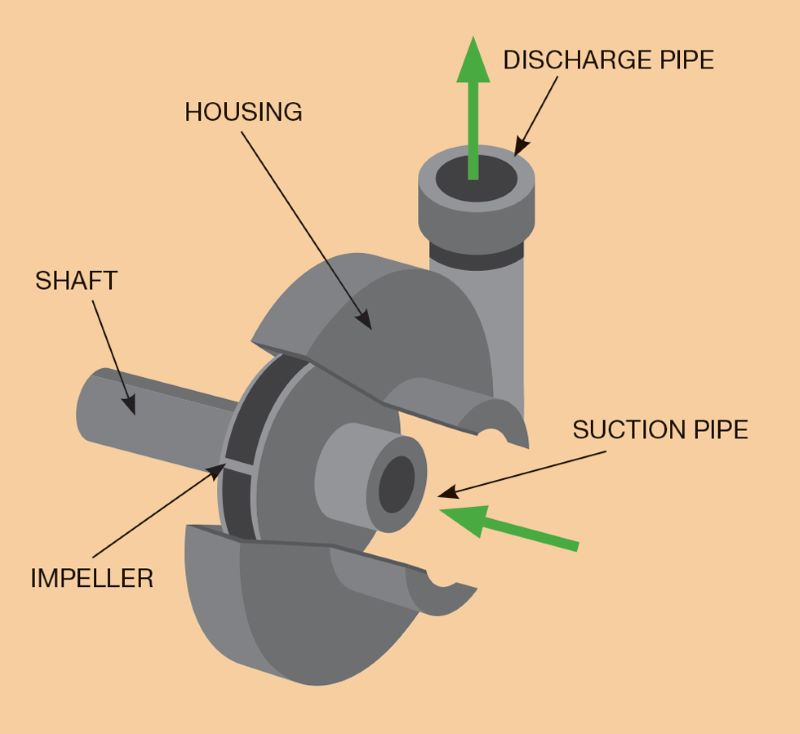
While Specific Gravity does not alter the head (height) a pump can generate, it linearly impacts the power required. The relationship is defined by the Brake Horsepower (BHP) equation:
BHP = (Q × H × SG) / (3960 × η_pump)
Where:
Q = Flow rate (US gpm)
H = Total Dynamic Head (ft)
η_pump = Pump efficiency (decimal)
High viscosity fluids drastically increase disk friction losses. According to Hydraulic Institute Standard 9.6.7, performance corrections must be applied when viscosity exceeds standard water values [2].
Impact: ↑ Viscosity ⇒ ↓ Head, ↓ Efficiency, ↑ Power.
Data: Pumping a fluid with a viscosity of 500 cSt can reduce pump efficiency by over 35% [3].
Suction conditions are widely cited in reliability reports as the leading cause of premature pump failure.
To prevent cavitation, the system must provide sufficient pressure at the suction eye. This is governed by the inequality:
NPSHa ≥ NPSHr + Margin
Cavitation occurs when local pressure drops below the fluid's vapor pressure (Pv).
Definition: ANSI/HI 9.6.1 defines the onset of damaging cavitation as the point where a 3% drop in head (NPSH3%) occurs due to vapor blockage [2].
Reliability Impact: Chronic cavitation causes pitting and vibration, potentially reducing seal and bearing life by up to 80%.
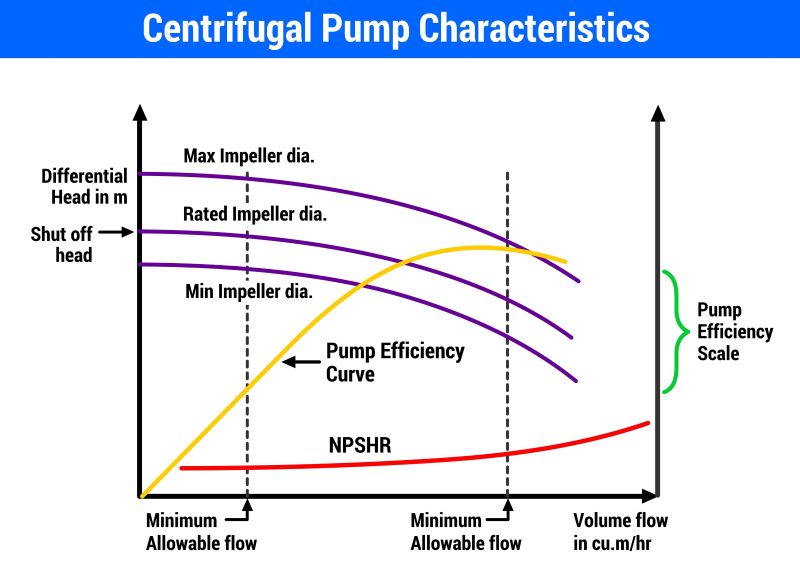
The behavior of centrifugal pumps under varying speeds is predicted by the Affinity Laws. These laws demonstrate that small reductions in speed yield exponential savings in energy, a principle leveraged by Variable Frequency Drives (VFDs).
Assuming constant impeller diameter (D1 = D2):
Flow: Q1 / Q2 = N1 / N2
Head: H1 / H2 = (N1 / N2)⊃2;
Power: P1 / P2 = (N1 / N2)⊃3;
The following table illustrates the impact of reducing pump speed by 10% and 20%:
| Speed (N) | Flow (Q) | Head (H) | Power (P) | Energy Savings |
| 100% | 100% | 100% | 100% | Base |
| 90% | 90% | 81% | 72.9% | ~27% |
| 80% | 80% | 64% | 51.2% | ~49% |
Pump efficiency is heavily dependent on volumetric efficiency (η_v), which is determined by internal leakage through wear rings.
As wear rings degrade, the clearance (C) increases, allowing high-pressure fluid to recirculate to the suction side. The leakage flow (Q_L) can be approximated by:
Q_L = C × π × D × √(2gΔH / K)
Industry Benchmark: For every doubling of the design clearance, overall pump efficiency decreases by approximately 1% to 1.5%.
Surface Finish: A study published in the Journal of Fluids Engineering indicates that polishing internal volute surfaces to reduce friction can improve hydraulic efficiency by 2% to 4% in cast iron pumps [5].
Reliability is strictly correlated to where the pump operates on its curve relative to the Best Efficiency Point (BEP).
Operating away from BEP creates unbalanced hydraulic forces.
Radial Thrust: Fr ∝ H × D2 × B2. At shut-off (zero flow), radial loads can be maximum.
MTBF Statistics: According to Bloch and Geitner, renowned pump reliability authors, pumps operating continuously within ±10% of BEP exhibit a Mean Time Between Failures (MTBF) up to three times longer than those operating outside the preferred operating region (POR) [6].
U.S. Department of Energy (DOE). (2006). Improving Pumping System Performance: A Sourcebook for Industry.
Hydraulic Institute. (2017). ANSI/HI 9.6.1-2017: Rotodynamic Pumps - Guideline for NPSH Margin.
Karassik, I. J., et al. (2008). Pump Handbook (4th Edition). McGraw-Hill Education.
Europump & Hydraulic Institute. (2004). Variable Speed Pumping: A Guide to Successful Applications.
Kurokawa, J., et al. (1998). "Effect of Surface Roughness on the Performance of Centrifugal Pumps." Journal of Fluids Engineering.
Bloch, H. P., & Budris, A. R. (2010). Pump User's Handbook: Life Extension (3rd Edition). Fairmont Press.
Ready to upgrade your pump system? Contact us now for a free consultation. Let's find the perfect fit for your industry.


