


close
Choose Your Site
Global
Social Media
Views: 154 Author: Patrick Publish Time: 2026-01-05 Origin: Site


In the industrial sector, cooling systems—including cooling towers, chillers, and heat exchangers—are critical for process stability but are massive energy consumers. According to the U.S. Department of Energy (DOE), industrial process cooling can account for 30% to 50% of a facility's total energy consumption [1].
Optimizing these systems is a financial and operational imperative. Below are data-driven strategies supported by thermodynamic principles and industry benchmarks.
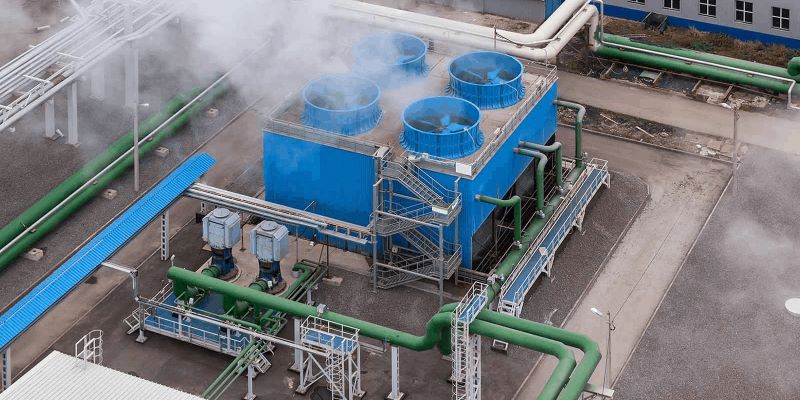
Traditional cooling systems often run fan motors at 100% capacity regardless of the actual thermal load. Installing Variable Frequency Drives (VFDs) allows the motor speed to match the load, exploiting the physics of fluid dynamics for exponential savings.
The relationship between power consumption (P) and fan speed (n) is governed by the Third Affinity Law, which states that power is proportional to the cube of the speed.
Formula:P₂ / P₁ = (n₂ / n₁)⊃3;
P: Power (kW)
n: Rotational speed (RPM)
The Implication: Reducing fan speed by just 20% results in a power consumption of only 51.2% of the original.
Calculation: 0.8⊃3; = 0.512 (approx. 50% reduction)
Authority Insight: ASHRAE Standard 90.1 mandates speed control for heat rejection fans larger than 7.5 HP, citing that VFD retrofits typically offer a Return on Investment (ROI) of under two years [2].
Water efficiency is strictly tied to Cycles of Concentration (CoC)—the ratio of dissolved solids in the blowdown water to the makeup water. Increasing CoC minimizes "bleed-off" (wastewater) and makeup water demand.
The relationship between makeup water savings and increasing cycles is non-linear. The efficiency gain plateaus as cycles increase, as shown in the data model below:
Table 1: Water Savings Analysis (Assumes 1,000 gallons evaporation loss)
Industry Report: According to the Cooling Technology Institute (CTI), increasing CoC from 3 to 6 reduces blowdown volume by 50%, significantly lowering water disposal costs [3].
Cycles of Concentration Makeup Water Required (gal) Percent Reduction 3.0 1,500 Baseline 4.0 1,333 11.1% 5.0 1,250 16.7% 6.0 1,200 20.0%
Fouling (biological growth) and scaling (mineral deposits) act as thermal insulators. We quantify this using the Overall Heat Transfer Coefficient (U).
The total resistance to heat transfer sums the convective resistances and the fouling factors.
Simplified Formula:1/U = 1/h(process) + 1/h(water) + R(fouling)
U: Overall heat transfer coefficient
R(fouling): The resistance caused by scale or biofilm
Even a minor increase in fouling drastically reduces efficiency. Research published in Applied Thermal Engineering indicates that a calcium carbonate scale thickness of just 0.6 mm can reduce overall heat transfer efficiency by 34% [4].
Strategic Action:
Implement automated biocide dosing to prevent biofilm. Biofilm acts as a powerful insulator, with a thermal conductivity much lower than steel, effectively trapping heat inside the system.
Moving from "run-to-failure" to predictive maintenance leverages IoT sensors to monitor vibration, acoustics, and temperature deltas.
Digital Twins: Creating a virtual replica of the cooling loop to simulate load changes.
The Impact: A report by McKinsey & Company highlights that AI-driven predictive maintenance can reduce machine downtime by 30–50% and extend machine life by 20–40% [5].
To ensure optimization, facility managers must track these thermodynamic KPIs:
| Metric | Formula / Definition | Target |
| Approach Temp | Cold Water Temp – Wet Bulb Temp | < 7°F (4°C) |
| Range | Hot Water Inlet – Cold Water Outlet | 10–15°F |
| Effectiveness (ε) | Range / (Range + Approach) | > 70% |
U.S. Department of Energy (DOE). Energy Efficiency Optimization of Industrial Cooling Systems.
ASHRAE. Standard 90.1: Energy Standard for Buildings Except Low-Rise Residential Buildings.
Cooling Technology Institute (CTI). Water Treatment and Conservation Guidelines (WTP-148).
Applied Thermal Engineering Journal. Impact of Fouling on Heat Exchanger Performance.
McKinsey & Company. Manufacturing: Analytics unleashes productivity and profitability.
Ready to upgrade your pump system? Contact us now for a free consultation. Let's find the perfect fit for your industry.


