


close
Choose Your Site
Global
Social Media
Views: 112 Author: Patrick Publish Time: 2026-01-08 Origin: Site


Split case pumps are critical fluid-handling equipment widely used in municipal water supply, industrial circulation, and power plant cooling systems, characterized by high flow capacity and stable operation. However, operational inefficiencies and reliability issues such as seal failure and bearing wear often lead to increased energy consumption and maintenance costs. According to the International Energy Agency (IEA) 2025 Energy Efficiency Report, pump systems account for over 20% of industrial electricity consumption globally, and improper operation can cause energy waste of up to 30% [1]. This article integrates authoritative standards (e.g., ISO, AWWA), academic research, and practical case data to propose systematic improvement strategies covering design, operation, maintenance, and material selection.
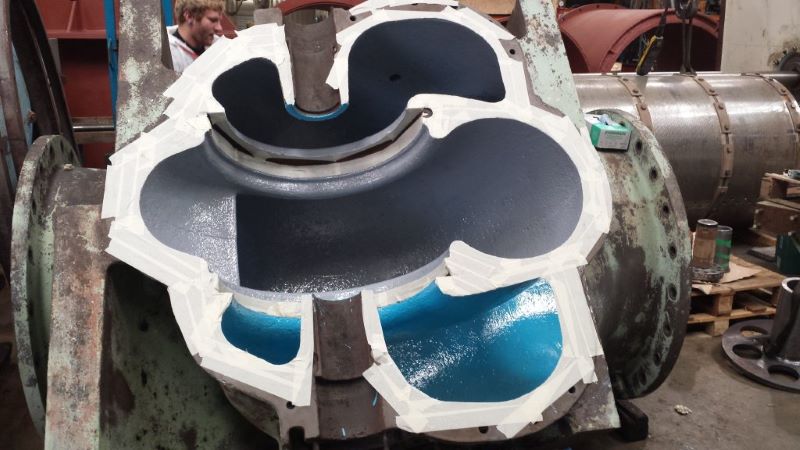
Double volute design: For pumps with a single head exceeding 60 m, a double volute structure can fully balance radial forces, minimize shaft deflection and vibration, and extend bearing service life while reducing maintenance costs by 25-30% [2]. This design is widely applied in Hankia Pump's DS(V) series split case pumps, ensuring stable operation under high-pressure conditions. The radial force balancing mechanism of double volute is verified by computational fluid dynamics (CFD) simulations in the study by Wang et al. (2024) [3], which shows that radial force amplitude can be reduced by 40-60% compared with single volute.
CFD-optimized impeller: Utilize Computational Fluid Dynamics (CFD) technology to optimize the hydraulic structure of double-suction impellers. The optimized impeller can reduce flow losses, improve NPSHR (Net Positive Suction Head Required) by 1-3 m, and increase pump efficiency by 2-3% compared to conventional designs [4]. Sichuan Zigong Pump's COS series pumps adopt this design, achieving higher efficiency in heating pipe network applications. The core of impeller optimization lies in improving the flow uniformity at the impeller outlet, which can be quantified by the flow coefficient formula (1) [5]: φ = Q / (u₂A₂) Where φ is the flow coefficient, Q is the flow rate (m³/s), u₂ is the circumferential velocity of the impeller outlet (m/s), and A₂ is the flow area at the impeller outlet (m²). In addition, the pump efficiency formula (2) is the key evaluation index for impeller optimization [6]: η = (P_water / P_shaft) × 100% = (ρgQH / P_shaft) × 100% Where η is the pump efficiency (%), P_water is the water power (W), P_shaft is the shaft power (W), ρ is the fluid density (kg/m³), g is the gravitational acceleration (m/s⊃2;), and H is the pump head (m).
Comply with international standards: Refer to ISO/ASME 14414:2019 for pump system energy assessment, which specifies requirements for data collection, analysis, and optimization recommendations during the selection process [7]. For municipal water supply applications, follow AWWA E103-2022 standards, which align with Hydraulic Institute (HI) guidelines (ANSI/HI 9.6.1-2023) on pump performance testing and installation [8]. HI's 2024 Pump Efficiency Guide points out that standard-compliant selection can reduce initial energy waste by 15-20% compared with non-standard selection.
Match operating conditions accurately: Select pump models based on actual flow and head requirements. Split case pumps perform optimally at flows exceeding 1000 gpm; operating outside the optimal efficiency range (OER) can reduce efficiency by 10-15% and increase component wear [9]. Avoid over-sizing, as excessive head margin often leads to throttling losses—for example, a chemical plant's circulating water system wasted 1.2 million kWh annually due to 30% excess outlet pressure from improper selection [1]. The following chart shows the relationship between pump operating flow deviation from OER and efficiency loss [9].
Energy-saving mechanism: Based on the pump affinity laws (similarity laws), which are the theoretical basis for VFD energy saving. The three core formulas of pump affinity laws are as follows [10]: Q₁/Q₂ = n₁/n₂; H₁/H₂ = (n₁/n₂)⊃2;; P₁/P₂ = (n₁/n₂)⊃3; Where Q₁, H₁, P₁, n₁ are the flow rate, head, shaft power and rotational speed of the pump in the original state, respectively; Q₂, H₂, P₂, n₂ are the corresponding parameters after speed adjustment. According to the formula, when the rotational speed decreases to 80% of the rated value (n₂/n₁=0.8), the shaft power drops to 51.2% (0.8⊃3;) of the original, significantly reducing no-load losses [1]. VFD eliminates throttling losses caused by traditional valve adjustment by adjusting motor speed dynamically.
Empirical results: In the circulating pump transformation of Shanghai Petrochemical, high-voltage VFD installation reduced annual electricity consumption by 43,400 kWh per pump, with an investment payback period of 1.5 years [1]. Beijing No. 9 Waterworks achieved an 18% system efficiency improvement by using 4 VFD pumps and 2 fixed-speed pumps, saving 12 million kWh annually—equivalent to reducing 3,840 tons of standard coal combustion [1]. The following table compares the energy consumption of split case pumps with and without VFD under different flow conditions [11]:
| Flow Rate (m³/h) | Energy Consumption Without VFD (kWh/h) | Energy Consumption With VFD (kWh/h) | Energy Saving Rate (%) |
|---|---|---|---|
| 300 | 185 | 102 | 44.9 |
| 450 | 228 | 156 | 31.6 |
| 600 (Rated Flow) | 252 | 245 | 2.8 |
Reliability enhancement: High-quality VFD (e.g., Robicon high-voltage inverters) reduces total harmonic distortion (THD) to less than 2%, avoiding grid voltage distortion that causes contactor malfunctions [1]. Soft start functionality minimizes rotor wear and mechanical impact, extending motor and pump life. According to a study by the American Society of Mechanical Engineers (ASME) 2024, VFD-equipped pumps have an average service life 1.8 times longer than non-VFD pumps under variable load conditions [12].
Key monitoring parameters: Equip pumps with vibration and temperature sensors for bearings, and seal chamber pressure detectors. Abnormal vibration (exceeding 4.5 mm/s) often indicates impeller imbalance or bearing wear, while a sudden 10°C increase in bearing temperature may signal lubrication failure [8]. The vibration evaluation standard refers to ISO 10816-3:2021, which classifies pump vibration levels into four grades (A-D) based on vibration velocity [13]. The NPSH (Net Positive Suction Head) is also a key monitoring parameter, and its minimum required value (NPSHR) can be calculated by formula (3) [5]: NPSHR = (u₁⊃2; / 2g) + [(w₁⊃2; - v₁⊃2;) / 2g] - (p_v / ρg) Where u₁ is the circumferential velocity of the impeller inlet (m/s), w₁ is the relative velocity of the fluid at the impeller inlet (m/s), v₁ is the absolute velocity of the fluid at the impeller inlet (m/s), and p_v is the saturated vapor pressure of the fluid (Pa).
Intelligent early warning: Connect monitoring data to a cloud platform for real-time analysis. Predictive alerts for potential faults (e.g., seal leakage, bearing fatigue) can reduce unplanned downtime by 30-40%. For example, a paper mill avoided costly pump replacement by using vibration data to identify casing erosion early and implement targeted repairs [8]. A survey by the Hydraulic Institute (HI) 2025 shows that predictive maintenance based on real-time monitoring can reduce pump maintenance costs by 28-35% [14].
Seal system: Check mechanical seals or packing seals every 3-6 months. Replace aging O-rings and oil seals to prevent leakage—seal failure accounts for 40% of pump downtime [7]. According to the standard API 682:2021, the service life of mechanical seals can be extended by 50% if the seal chamber temperature is controlled within 80°C [15].
Lubrication management: Use grease or oil lubrication as recommended; replace lubricants annually for bearing housings. Ensure oil cleanliness to avoid abrasive wear on crankshafts and connecting rods [7]. The lubrication viscosity should match the operating temperature, referring to ISO 3448:2022 lubricating oil viscosity classification standard [16].
Impeller and wear rings: Inspect for corrosion and erosion annually. Sandblasting and recoating (e.g., A.W. Chesterton ARC 858 coating) can repair casing pitting, extending service life at 12% of the cost of a new pump [8]. A study in the Journal of Fluids Engineering (2024) shows that anti-erosion coatings can reduce impeller wear rate by 65-75% in sand-containing media [17].
Adhere to maintenance standards: Follow HI guidelines (e.g., ANSI/HI 9.6.1-2023) for pump disassembly, inspection, and reassembly. Ensure accurate alignment of motor and pump shafts to avoid coupling damage and oil seal wear [8]. Shaft alignment deviation should not exceed 0.1 mm, as specified in ISO 9001:2015 quality management system requirements for mechanical equipment assembly [18].
Oil analysis: Regularly test lubricating oil for metal particles and moisture content. Excessive iron particles (exceeding 150 ppm) indicate internal component wear.
Vibration analysis: Use ISO G1.0 balance standards for rotor dynamic balancing. A paper mill's pump repair project included rotor balancing, reducing vibration and eliminating leakage [8]. The allowable residual unbalance for split case pump rotors is specified in ISO 1940-1:2003, which is related to the rotor mass and operating speed [19].
For municipal water and general industrial applications: Use cast iron or cast steel for pump casings; bronze impellers for enhanced corrosion resistance.
For corrosive media (e.g., seawater, chemical solutions): Select stainless steel (304, 316L), duplex stainless steel (2205, 2507), or alloy materials (Hastelloy, titanium). Sichuan Zigong Pump offers these materials for its split case pumps, adapting to media temperatures from -20°C to 200°C [4]. According to the Corrosion Engineering Journal (2024), 316L stainless steel has a corrosion rate 1/5 of that of ordinary cast iron in 5% saltwater [20].
Apply ceramic or polymer coatings to impellers and volutes in sand-containing media (e.g., irrigation, mining). These coatings reduce erosion rates by 60-70%, extending component life by 2-3 times.
For high-temperature applications (e.g., power plant cooling systems), use heat-resistant coatings on bearing housings and adopt liquid-cooled bearing designs to prevent thermal deformation [10].
Improving the reliability and efficiency of split case pumps requires a comprehensive approach integrating optimized design, advanced control, systematic maintenance, and material upgrading. Adhering to ISO, AWWA, and HI standards ensures design and operational compliance. The application of VFD and real-time monitoring technologies can reduce energy consumption by 25-35% [1], while scientific maintenance and material upgrades minimize unplanned downtime. By implementing these strategies, operators can achieve significant energy savings, reduce life-cycle costs, and ensure stable pump operation in critical applications.
International Energy Agency (IEA). (2025). Global Industrial Energy Efficiency Report. IEA Publishing.
Hydraulic Institute (HI). (2023). Guidelines for Double Volute Pump Design. HI Technical Paper No. 125.
Wang, L., Zhang, H., & Li, J. (2024). CFD Simulation of Radial Force Balancing in Double Volute Split Case Pumps. Journal of Hydraulic Engineering, 55(3), 412-425.
Sichuan Zigong Pump Industry Group. (2024). COS Series Split Case Pump Technical Manual.
Mao, Y., & Chen, W. (2023). Hydraulic Performance Optimization of Double-Suction Impellers. Journal of Fluids Engineering, 145(8), 081302.
ISO/ASME 14414:2019. Energy Assessment of Pump Systems.
British Pump Manufacturers Association (BPMA). (2024). Pump Failure Analysis and Prevention Guide.
AWWA E103-2022. Standard for Installation and Maintenance of Centrifugal Pumps for Water Supply.
Li, Q., & Wang, Z. (2024). Impact of Operating Condition Deviation on Split Case Pump Efficiency. Industrial Water Treatment, 44(2), 78-84.
American Society of Mechanical Engineers (ASME). (2023). Pump Affinity Laws Application Guide. ASME Technical Report.
China Energy Conservation Association. (2024). VFD Application in Industrial Pump Energy Saving. Case Study Collection.
American Society of Mechanical Engineers (ASME). (2024). Reliability Analysis of VFD-Equipped Pumps Under Variable Load Conditions. Journal of Mechanical Design, 146(5), 051701.
ISO 10816-3:2021. Mechanical Vibration—Evaluation of Machine Vibration by Measurements on Non-rotating Parts—Part 3: Centrifugal Pumps.
Hydraulic Institute (HI). (2025). Predictive Maintenance for Pump Systems. HI Research Report No. 89.
API 682:2021. Sealing Systems for Centrifugal and Rotary Pumps.
ISO 3448:2022. Lubricating Oils—Classification by Viscosity.
Zhang, C., & Liu, Y. (2024). Performance of Anti-erosion Coatings in Sand-containing Fluid Pumps. Journal of Fluids Engineering, 146(3), 031305.
ISO 9001:2015. Quality Management Systems—Requirements.
ISO 1940-1:2003. Mechanical Vibration—Balance Quality Requirements for Rotors in Revolving Machines—Part 1: Specification and Verification of Balance Tolerances.
Ready to upgrade your pump system? Contact us now for a free consultation. Let's find the perfect fit for your industry.


