


close
Choose Your Site
Global
Social Media
Views: 165 Author: Patrick Publish Time: 2025-12-17 Origin: Site


Energy Performance Contracting (EPC) is a financial mechanism designed to accelerate facility modernization and decarbonization by using future operational savings to fund capital upgrades.
According to the International Energy Agency (IEA), the global market for Energy Service Companies (ESCOs) has seen sustained growth, with the market value exceeding $37 billion recently. This growth is driven by the urgent need for energy efficiency in the built environment, which accounts for nearly 40% of global CO2 emissions.
"Performance contracting is a proven methodology for modernizing infrastructure and reducing emissions without upfront capital expenditure." — U.S. Department of Energy (DOE), Better Buildings Initiative [1]
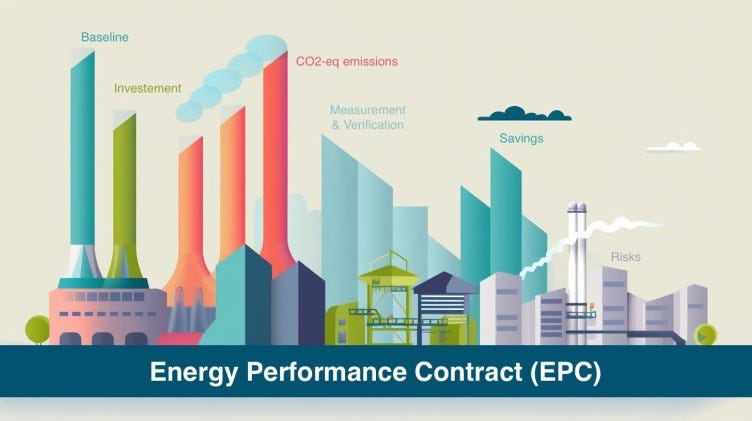
Success begins with rigorous data aggregation. The facility owner must establish the technical and economic viability of the project before engaging external partners.
Accurate historical data is non-negotiable. You must aggregate at least 24 to 36 months of utility data.
Energy Use Intensity (EUI): Calculate the EUI to benchmark against peer facilities using ASHRAE Standard 100 methodologies.
EUI = (∑ E_total) / A_gross
Where:
E_total = Total energy consumed in one year (converted to kBTU or kWh)
A_gross = Gross floor area (ft⊃2; or m²)
Identify aging infrastructure that has exceeded its useful life. According to ASHRAE, commercial HVAC equipment generally has a service life of 15–20 years. Replacing equipment near failure within an EPC maximizes the "cost of inaction" savings.
The Investment Grade Audit (IGA) is a binding engineering study. It transforms estimates into guaranteed metrics.
When selecting an ESCO, evaluate their "Savings Persistence" record.
Reference: A study by Lawrence Berkeley National Laboratory (LBNL) indicates that public sector EPC projects typically deliver median savings of 17% to 23% of baseline energy costs [2].
The IGA determines the feasibility based on the Simple Payback Period (SPP). While EPCs use complex financing, the foundational metric remains:
SPP = C_project / (∑ S_annual)
Where:
C_project = Total installed cost of Energy Conservation Measures (ECMs)
S_annual = Verified annual cost savings
Industry Insight: LBNL reports that the average cost for an IGA ranges from $0.04 to $0.50 per square foot, depending on facility complexity. This cost is typically rolled into the project financing if the project proceeds.
Understanding risk allocation is critical. The table below outlines the risk distribution between the Client and the ESCO for the two primary models.
| Risk Category | Guaranteed Savings (EPC) | Shared Savings |
| Performance Risk | ESCO | ESCO |
| Credit/Financing Risk | Client | ESCO |
| Design/Construction Risk | ESCO | ESCO |
| Interest Rate Risk | Client | ESCO |
Guaranteed Savings: The standard model in the U.S. (approx. 85% of market). The ESCO guarantees the savings S_guaranteed will meet debt service D_service.
If S_actual < S_guaranteed, then ESCO pays (S_guaranteed - S_actual)
Execution requires strict adherence to ASHRAE Guideline 0 (The Commissioning Process).
Operational Continuity: Implementation plans must prioritize zero downtime for critical environments (e.g., healthcare, data centers).
Hazardous Materials: Management of asbestos or lead abatement is often required during boiler or chiller removal.
Installation is insufficient; systems must be tuned.
Functional Testing: Verifying that VFDs (Variable Frequency Drives) and BMS controls operate according to the design intent.
Optimization: Adjusting set-points for part-load efficiency, which is where systems operate 95% of the time.
The "guarantee" is legally defined by the M&V plan. This must adhere to the International Performance Measurement and Verification Protocol (IPMVP), maintained by the Efficiency Valuation Organization (EVO).
Savings are not measured directly; they are calculated. The fundamental IPMVP equation is:
S_savings = (B_energy - P_energy) ± A_routine ± A_non-routine
Where:
B_energy = Baseline Energy Use (pre-retrofit)
P_energy = Post-Retrofit Energy Use
A_routine = Adjustments for expected factors (e.g., Weather/Degree Days)
A_non-routine = Adjustments for unexpected changes (e.g., adding a new wing to the building, COVID-19 occupancy shifts)
Option A: Retrofit Isolation (Key Parameter Measurement). Best for: Lighting upgrades.
Option C: Whole Facility (Meter Analysis). Best for: Complex HVAC retrofits affecting the whole building.
"Properly applied M&V is the cash register of the energy performance contract. It ensures the savings stream remains whole." — Energy Services Coalition (ESC) [3]
U.S. Department of Energy (DOE). Energy Savings Performance Contracting Toolkit.
Lawrence Berkeley National Laboratory (LBNL). ESCO Industry Trends and Market Analysis Reports.
Energy Services Coalition (ESC). Best Practices in Measurement & Verification.
ASHRAE. Standard 100: Energy Efficiency in Existing Buildings.
Ready to upgrade your pump system? Contact us now for a free consultation. Let's find the perfect fit for your industry.


