


close
Choose Your Site
Global
Social Media
Views: 123 Author: Patrick Publish Time: 2025-09-19 Origin: Site


In September 2025, the latest report from the International Energy Agency (IEA) points out that systematic energy management is the key to unlocking industrial energy efficiency potential and enhancing competitiveness. The global industrial sector could save up to $600 billion annually in energy costs, with digital technologies such as artificial intelligence (AI) emerging as new accelerators.
At the 28th UN Climate Change Conference (COP28), nearly 200 countries reached a historic agreement, committing to double the global energy efficiency improvement rate by 2030. However, the reality is worrying: the global energy efficiency improvement rate has slowed from around 2% over the past decade to just over 1% today. A major contributing factor is the stagnation of energy efficiency progress in the industrial sector.
Industry is a major consumer of energy and emitter of carbon globally, accounting for 39% of final energy demand and as much as 45% of carbon emissions.
Yet crises harbor tremendous opportunities. The report finds that within IEA member countries alone, if industrial enterprises worldwide can achieve the energy efficiency level of the top 25% in their respective sub-sectors, annual cost savings could reach $600 billion. While not all companies can match the benchmark level, this staggering figure highlights the significant energy-saving potential of promoting current best practices.
Unlike piecemeal energy-saving projects, energy management aims to proactively conduct systematic monitoring, analysis, control, and optimization of energy use—a continuous improvement process. It is not merely an investment in equipment and technology, but the integration of energy efficiency into daily business operations.
A one-time energy audit is like a "health check-up," providing a list of energy-saving opportunities; energy management, by contrast, is ongoing "health management," ensuring these opportunities are identified, implemented, and continuously deliver benefits.
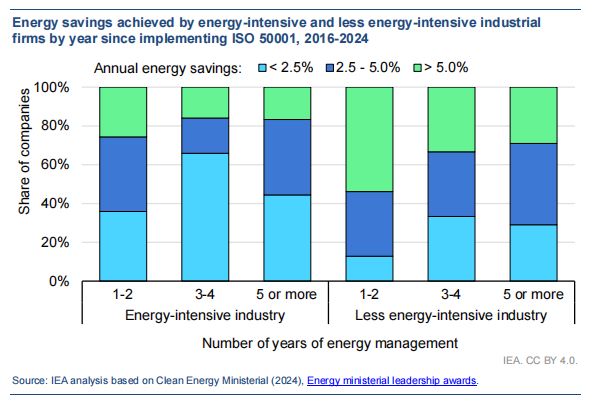
Practice has proven that enterprises adopting systematic energy management achieve remarkable energy-saving results. Data shows that companies implementing standards such as ISO 50001 (Energy Management System Standard) can achieve an average energy saving of 11% within the first three years—far higher than the overall industrial energy intensity improvement rate of 1%. Many enterprises have even achieved energy savings of 30% or more, often at little to no cost.
Investing in energy management yields far more than lower electricity bills. The report emphasizes that when all multiple benefits are accounted for, the total value can exceed twice the direct energy-saving benefits.
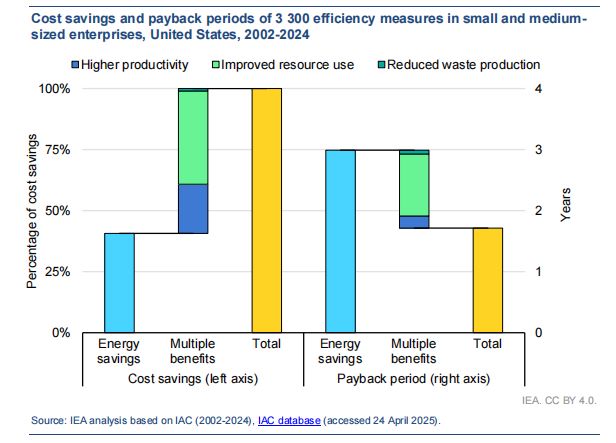
Energy management improves productivity and product quality, reduces equipment downtime and maintenance costs, enhances workplace health and safety, and strengthens supply chain resilience...
Energy management boosts energy security, eases grid stress, frees up grid capacity to support the integration of renewable energy and electrification...
Digital tools and AI are revolutionizing energy management:
Intelligent Predictive Maintenance: Use AI to analyze sensor data, predict failures, schedule maintenance, and reduce downtime.
Automated Quality Control: AI-powered automated inspection accurately identifies defects, ensuring product quality and reducing errors and waste.
Digital Twin Simulation: AI provides predictive insights and manages complex data required for twin models.
Precise Demand Forecasting: Optimize production plans, inventory management, and equipment efficiency based on historical data and market trend analysis.
Real-Time Optimization and Control: Analyze real-time data to monitor operations, identify bottlenecks, and enable rapid responses; optimize manufacturing processes, stabilize product quality, and reduce waste by adjusting parameters in real time.
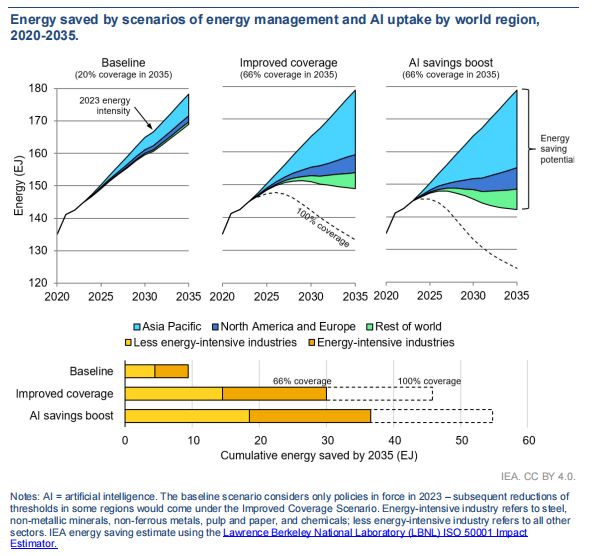
The report estimates that widespread adoption of AI by 2035 could reduce global industrial energy consumption by an additional 8 exajoules (EJ)—equivalent to Mexico’s current total energy consumption. Combining AI-driven energy-saving scenarios with the widespread adoption of energy management could lower energy consumption per unit of value added by 28% in 2035 compared to the baseline scenario.
Systematic energy management is no longer an option, but an indispensable path for industry to maintain competitiveness and achieve sustainable development in the era of energy transition. For enterprises and governments, investing in energy management now will deliver substantial economic, environmental, and security returns in the decades to come.
Ready to upgrade your pump system? Contact us now for a free consultation. Let's find the perfect fit for your industry.


